
服务承诺
 资金托管
原创保证
实力保障
24小时客服
使命必达
资金托管
原创保证
实力保障
24小时客服
使命必达
51Due提供Essay,Paper,Report,Assignment等学科作业的代写与辅导,同时涵盖Personal Statement,转学申请等留学文书代写。
 51Due将让你达成学业目标51Due将让你达成学业目标51Due将让你达成学业目标51Due将让你达成学业目标
私人订制你的未来职场 世界名企,高端行业岗位等 在新的起点上实现更高水平的发展
 积累工作经验
 多元化文化交流
 专业实操技能
 建立人际资源圈
Global Warming Effects on Polar Bears
2018-12-08 来源: 51due教员组 类别: Paper范文
下面为大家整理一篇优秀的paper代写范文- Global Warming Effects on Polar Bears,供大家参考学习,这篇论文讨论了全球变暖对北极熊的影响。随着全球变暖现象的加剧,越来越多的冰川和永久冻土层正在融化。随着浮力面积的减少,北极熊的生存环境受到了严重而显著的影响。这意味着北极熊必须长途跋涉才能找到合适的藏身之处和食物。从这个意义上说,北极熊已经受到全球变暖趋势的影响。负面影响主要表现在食物匮乏、数量减少、生存环境被破坏和北极熊繁殖等方面。
Introduction
Nowadays, the climate change has been viewed as the most influential environmental problem for the human kind in modern society. The climate change not only influences the human life patterns, but also changes the living style for many wild animals. More and more people feel it necessary to take effective measurements to deal with the climate change. For the polar bears, their life and habitat are being seriously affected by the global warming, attracting wide attention from the whole world.
Knowledge of Polar Bears
The polar bear, as can be seen from its name, is the largest land carnivore that only live in the Arctic Pole. The polar bears are able to survive in the extremely harsh environment, which mainly spread within the scope of the floating ice belt, nearby islands and adjacent mainland coastline surrounding the Arctic Pole. In general, polar bears would never go to other northern areas, due to the over thick floating ice. Even the seals fail to burst through the thick floating ice. Without food, polar bears naturally refuse to the take risks in thick floating ice areas. This means that the natural living habit is of great to polar bears’ survival. The distribution situation of polar bears shows a circumpolar tendency, thus they can be seen in five major nations, namely the Denmark, Norway, Russia, America, as well as Canada.
The polar bears are recognized as the most outstanding swimmers, thus they used to be considered as Marine animals. In most of the time, polar bears prefer to keep still, like sleeping, lying or waiting for prey. They spend the left time on walking on the land or swimming in the sea. Polar bears have overwhelming attack forces. They are also the only kind of bear initiatively attacking human beings, which occurs mostly in the night. As for its feeding habits,polar bears belong to real predators in the Ursidae family, thus the dominant proportion of their food resources come from meat. Polar bears mainly feed on seals, especially the ringed seal, the beard, the saddle seal and the hooded seal. Apart from seal, polar bears also prey on creatures like walrus, the white whale, sea birds and some fish. Seaweeds are needed to compensate for minerals and vitamin substances.
As a result of the climate change, the global warming tendency is becoming more and more obvious, leading the number of floating ice being largely decreased and the living habitat for polar bears being severely influenced. According to the Polar Bears International, scientist make a prediction that people will lose wild polar bears by 2100 if no action is taken on climate change, indicating two-thirds polar bears will be gone by 2050 following this tendency.
Knowledge of Global Warming
Global warming is a climate change associated with the natural phenomenon. In specific, when people burn fossil fuels such as oil and coal, there will be the production of large amounts of carbon dioxide. It deserves wide attention that a wide range of human behavior in daily lives can lead to the acceleration of the process of global warming. The global warming issue indicates that human beings should be accounted for the climate change.
Carbon dioxide is a kind of greenhouse gas. The greenhouse gas has a high permeable effect on the visible sunlight radiation while shows strong absorbent power in the long wave radiation from the earth. By absorbing the infrared ray from the ground radiation, greenhouse gas finally leads to the rise of temperature, in other words, the greenhouse effect. When greenhouse effect increasingly accumulates, the phenomenon of global warming eventually occurs. Global warming will cause the redistribution of global precipitation, the melt of glaciers and permafrost, and the rise of sea level. All the changes not only break the original balance of natural ecosystem but also threaten the survival of human beings (Root, Price & Hall et al, 2003).
Global Warming Effects on Polar Bears
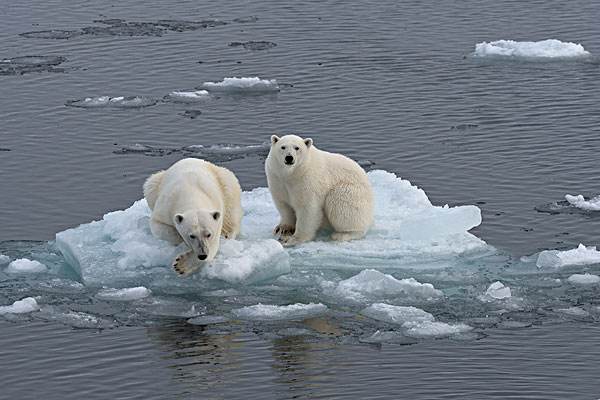
As global warming phenomenon is increasing, there are more and more glaciers and permafrost being melted. With the reduced floating area, the living habitat for polar bears has been seriously and significantly influenced. This means that polar bears have to travel long distances in order to find proper hiding places and food. In this sense, the polar bears have been affected by the global warming tendency. The negative influences are mainly reflected in the following ways, the food scarcity, the decreasing amount, the damaged survival environment and the polar bear reproduction.
Global warming produces the food scarcity problems for a large number of polar bears. There are two factors accounting for the food scarcity. For one thing, it is necessary to learn how polar bears prey on food in their daily lives. As has been stated, polar bears mainly feed on some kinds of seals, but they have weaker ability in swimming under the floating ice when compared with skillful seals (Derocher, Lunn& Stirling, 2004). Once the seals dive underwater, polar bears usually ended in failure when going after the seals. Therefore, polar bears have to search for those seals which are lying on floating ice. The real situation is that the old and experienced seals in the Arctic Pole would lie on the edge of floating ice when having a rest, thus they are able to make a quick response to polar bears’ attack by diving underwater. For the fresh and innocent seals, they may be captured lacking in essential self-defense awareness. It can be seen that the polar bears can merely prey on those small and sick seals, and are never capable to capture those young and vigorous seals, indicating their food condition deserves public concerns. For another thing, it should be noticed that floating ice matters a lot when polar bears prey on seals. Polar bears have a preference to follow the floating ice, this means where there is plenty of floating ice, there will be more polar bears. And this is caused by polar bears’ eating habits. Limited by weak swimming power, the polar bears need to walk on the floating ice. The floating ice is also the proper place for polar bears to hunt for seals. As global warming gradually melts the floating ice, it is becoming more and more difficult for polar bears to prey on seals (Derocher, Lunn& Stirling, 2004). More seriously, some polar bears are seen to be trapped on the left floating ice, which are surrounded with sea water.
Global warming leads to the decreasing number of polar bears. As the global weather is becoming warmer and warmer, it is inevitably that the floating ice belt shrinks little by little. While polar bears rely on floating ice for survival, they gradually find it more and more difficult to hunt for food. So they have to take new actions to survive. While making efforts to survive under the changing environment, many polar bears become sick or even dead, thus the amount of polar bears is less and less. For instance, they are risking their lives and health when riding on the floating ice for searching for more open floating ice belt. However, the increasing temperature gradually melts the existing floating ice. When polar bears walking on the floating ice, some of the ice is likely to melt at any time. To a certain extent, the melting ice then cannot support the weight and the size of the huge polar bears, making many polar bears fall into the ice water as a result. Although polar bears are born to swim, however, they are only capable of swimming for a relatively short distance for about forty or fifty miles. When polar bears fall into the ice water that far away from other floating ice or the offshore area, the polar bears have no choice but to swim for a long journey for survival. With the decreased fat reserves, the polar bears will suffer from exhaustion and hypothermia while swimming in the ice water, with the end of being drowned alive unfortunately.
The living environment for polar bears has been largely damaged due to the severer and severer global warming tendency. It is known that polar bears belong to the mammals rather the Marine animals. People take polar bears as excellent swimmers, but they are just not good at swimming for a long distance. Floating ice is necessary for their daily movements and survival in essence. In face of the separated floating ice due to the global warming, even the excellent swimmer, the polar bears are likely to be drowned, as the swimming distance excesses their average swimming ability. Moreover, swimming in the freezing cold water for a long time will take plenty of energy and fat away from the polar bears. Being exhausted and tired, the poor polar bears are forced to swimmer longer in order to search for food and to go to the islands. Nevertheless, the endless loop usually ends with the death of polar bears, largely decreases the survival rate for them. With the melting floating ice, polar bears have to swim for more than 50 kilometers, a long and challenging distance for them. Sharon argues that polar bears nowadays swim for days as sea ice retreats, which can tire them and cause them to lose weight and become weaken (Oosthoek, 2016). His argument is concluded from a scientific research tracking the bears during the year from 2007 to 2012. It was in 2012 that the Arctic sea ice reached a record low in history. Thus 69 percent of the bears tracked in the Western Arctic’s Beaufort Sea swam more than 50 kilometers at least once (Oosthoek, 2016). The collected data this year was more than two out of every three of the bears studied there (Oosthoek, 2016). Based on another research taken by the scientists from the University of Alberta and Environment and Climate Change Canada (2016), the pattern of long-distance swimming by polar bears in the Beaufort Sea shows the fingerprint of the climate change, indicating the increasing swim occurrence is associated with the sea ice melting frequency and moving father from shore during the summer (Nicholas, Alysa McCall & Andrew et al, 2016). Despite of the polar bear differences sex, age, body size and regional features, they all show an increasing swimming frequency, which leads to the rise of energy cost. If the floating ice loss tendency is out of control, much severer implications for the decreased populations of the polar bears living around the Arctic Basin will occur eventually (Nicholas, Alysa McCall & Andrew et al, 2016).
Global warming even threaten the polar bear reproduction to a large extent. Polar bears are known to the public as the is the largest land carnivore, however, the reproduction rate of polar bears is much lower when compared to other mammals. The female polar bears are able to have sexual maturity after growing up to five years old. Most of the female polar bears have two baby polar bears during the pregnancy, with only half survival rate. Besides, the mother polar bears need to wait two or three years for the growing up of their babies before next pregnancy. It should be noticed that the most influential factor contributing to polar bears’ reproduction is whether they are able to have adequate hibernation during the winter. While spending hibernation period, the female bears would store much of their fat for feeding the young generation. The adequate solid ice is also a necessity for them to reproduce and take after the baby polar bears. Nevertheless, the global warming has significantly changed the reproduction and living habit for the polar bears, due to the shortage of thick and solid sea ice. Nowadays, the hibernation behavior generally differs from regions to regions, according to the existence of sea ice. In general, many male polar bears and female polar bears without pregnancy give up hibernation or just hibernate for a short period. Whether they are able spend a long hibernation time is determined by the food sufficiency situation. Polar bears would discard hibernation when they have enough food sufficiency. Given serious shortage of food, polar bears would hibernate. In reality, the polar bear hibernation is not only for winter protection but also for survive the severe food shortage period. This is a kind of animal instinct in response to the outside world disadvantage and threat. The global warming has melted plenty of floating ice. If the no ice period extends in Arctic summer, the polar bears have to stay on the shore hungry and weak. With the delay of the ice period, the polar bears find no ways to get the necessary fat storage, which is of vital importance to their life and survival. This will negatively affect the female polar bears’ reproduction ability in turn, continuing with the damaged milk reproduction ability for them. For the female polar bears, they spend much of their fat storage during the hibernation, some of which is used to make milk for feeding, and the left of which is for maintaining body temperature. For these reasons, there is an obvious rate fall in polar bear reproduction. If the sea ice continues to melt year by year, there will be one day that polar bears are tapped in the sea and fail to return to build the ice nest for reproduction.
Cause Analysis of Global Warming
The greenhouse effect eventually leads to the global warming. As far as people are concerned, human beings have warmer winter and cooler summer, without too much serious consequences seemingly. So, people just wonder why the global warming can make polar bears being hungry, homeless and even endangered?
The Arctic Pole shows the most intense and apparent response to the global warming phenomenon. It is also the homeland for the polar bears. There are basically two kinds of Arctic ice coverings. One kind are the sea ice coverings that covering on the Arctic Ocean. The other kind are the island coverings that cover the land islands. When compared with the ice coverings on the island coverings from the Greenland, the Arctic Ocean coverings are soaked in the Arctic Ocean, which contains a large amount of thermal energy. In this way, the Arctic Ocean covers shows a much quicker melting speed. In the past a few years, there has been obvious change between the western sea ice and the northern sea ice in the distance from the coast. The western and northern sea ice used to become almost unified several decades ago, however, a quite long distance can be seen between the sea ice and the coast nowadays. This is how the global warming has changed the Arctic Pole and damaged floating ice in recent years.
The physical principles account for the accelerating speed of melting Arctic sea ice. The white ice used to reflect the most sunlight back. With melting ice, the sea water comes out. Darker than ice, the sea water can absorb more sunlight and improves its temperature, which leads to more ice to melt. Therefore, the vicious circle continues, making winter less likely to be frozen. When making a detailed analysis of a series of events leading to the decreasing polar bears, people would be surprised to find that human activities are closely related to the situation as the ultimate root is attributed to global warming. People are supposed to increase their knowledge of human behaviors and perceptions of the behaviors’ impact on causing and mitigating the climate change (Truelove, Parks, 2012). The temperature change on the earth is largely determined by the amount of greenhouse gases in the atmosphere especially the carbon dioxide and the methane. Over the past century, the carbon dioxide concentrations have begun to surge dramatically with the progress of industrial revolution, with a rise of over 30% (Bogan, Ohde & Arakaki et al, 2009). The man-made greenhouse gases gradually cause the excessive greenhouse effect and global warming eventually.
WWF Efforts in Protecting Polar Bears
In face of the global warming effect on polar bears, there have been endless efforts trying to improve the current situation. The World Wide Fund (WWF) is the largest, independent and non-governmental environmental protection organization, which enjoys worldwide recognition, popularity and reputation. Since its establishment in 1961, WWF has been committed to be the leading environment conservation organization, being engaged in projects with more than 100 countries supported by more than one million members in the United States and close to five million globally (WWF). The main areas include forests, oceans, fresh water, wildlife, food and climate. WWF has taken a number of measures trying to reduce the human impact on climate, especially the global warming, which also play an important role in protecting the polar bears.
The Earth Hour is a global energy conservation activity propose by the WWF to address the global warming. WWF encourages everyone to save electricity for over an hour by turning off unnecessary lights on the last Saturday night in March. Developed and run as a World Wildlife Fund (WWF) project in Sydney, Australia, Earth Hour was launched in 2007 as a symbolic “lights off” event (Sison, M. D, 2013). People can show their support for dealing with global warming this way. WWF argues that only when the public changes their carbon dioxide attitude, with the global warming be controlled. Now, the Earth Hour has been promoted for ten years.
The Amazon Rain Forest is the largest carbon dioxide releasing area containing a large amount of carbon. It is common to see people cut down and burn the trees here. WWF has been completing the forest protection regulations to help these people with their rain forest, aiming to end illegal logging. Many local enterprises also cooperate with the WWF to decrease the carbon dioxide release. In addition, WWF has collect large amount of fund to manage the forest protection. This is a big move for WWF to control the carbon dioxide release.
Showing great concern to the polar bears, WWF is working with the Coca-Cola Company to make further protective measurements. With Coca-Cola’s support since 2007 of WWF’s polar bear conservation efforts, WWF launched the Arctic Home Campaign in North America during the 2011 holiday season to raise widespread awareness and funds for these efforts (WWF). The Coca-Cola’s advertisement of polar bears has been impressive in motivating more people to participate in protection polar bear activities.
As far as the WWF is concerned, the wild animals especially the life of polar bears are being significantly influenced by the climate change, the global warming. The influences may include their life circles and the species survival. WWF is playing a leading role in making a positive response to the global warming.
References
Bogan, R. A. J., Ohde, S., Arakaki, T., Mori, I., & Mcleod, C. W. (2009). Changes in rainwater is associated with increasing atmospheric carbon dioxide after the industrial revolution. Water, Air, & Soil Pollution, 196(1), 263-271.
Derocher, A. E., Lunn, N. J., & Stirling, I. (2004). Polar bears in a warming climate. Integrative & Comparative Biology, 44(2), 163-176.
Nicholas W. Pilfold, Alysa McCall, Andrew E. Derocher, Nicholas J. Lunn, Evan Oosthoek S. “Polar bears swim for days as sea ice retreats.” Science News for Students, 2016. Web. 23 May 2016.
https://www.sciencenewsforstudents.org/article/polar-bears-swim-days-sea-ice-retreats
Richardson. Migratory response of polar bears to sea ice loss: To swim or not to swim. Ecography, 2016; DOI: 10.1111/ecog.02109
Root, T. L., Price, J. T., Hall, K. R., Schneider, S. H., Rosenzweig, C., & Pounds, J. A. (2003). Fingerprints of global warming on wild animals and plants. Nature, 421(6918), 57-60.
Sison, M. D. (2013). Creative strategic communications: a case study of earth hour. International Journal of Strategic Communication, 7(4), 227-240.
Truelove, H. B., & Parks, C. (2012). Perceptions of behaviors that cause and mitigate global warming and intentions to perform these behaviors. Journal of Environmental Psychology, 32(32), 246–259.
WWF. https://www.worldwildlife.org/about
WWF. WWF and The Coca-Cola Company Team Up to Protect Polar Bears.
https://www.worldwildlife.org/projects/wwf-and-the-coca-cola-company-team-up-to-protect-polar-bears
51due留学教育原创版权郑重声明:原创paper代写范文源自编辑创作,未经官方许可,网站谢绝转载。对于侵权行为,未经同意的情况下,51Due有权追究法律责任。主要业务有essay代写、assignment代写、paper代写服务。
51due为留学生提供最好的paper代写服务,亲们可以进入主页了解和获取更多paper代写范文 提供作业代写服务,详情可以咨询我们的客服QQ:800020041。