
服务承诺
 资金托管
原创保证
实力保障
24小时客服
使命必达
资金托管
原创保证
实力保障
24小时客服
使命必达
51Due提供Essay,Paper,Report,Assignment等学科作业的代写与辅导,同时涵盖Personal Statement,转学申请等留学文书代写。
 51Due将让你达成学业目标51Due将让你达成学业目标51Due将让你达成学业目标51Due将让你达成学业目标
私人订制你的未来职场 世界名企,高端行业岗位等 在新的起点上实现更高水平的发展
 积累工作经验
 多元化文化交流
 专业实操技能
 建立人际资源圈
Douglas's influence on the abolitionist movement
2019-05-08 来源: 51due教员组 类别: 更多范文
下面为大家整理一篇优秀的assignment代写范文- Douglas's influence on the abolitionist movement,供大家参考学习,这篇论文讨论了道格拉斯对废奴运动的影响。弗雷德里克·道格拉斯无疑是带领非裔美国人摆脱压迫的先驱。作为美国历史上杰出的革命领袖之一,弗雷德里克·道格拉斯始终为废奴运动做出了巨大的贡献。当他意识到宪法和国家制度并没有从他的思想开始构思时,他发表了呼吁变革的演讲,非常有效和鼓舞人心。尽管道格拉斯并没有领导一场身体上的反抗,但他的提议为困惑的公民们指明了一道光,让他们为自己的权利和幸福而战。
Music and songs have always been the euphemistic but articulate tools for human beings to express their message to the world, especially for folk songs that are transmitted to next generations as spirit heritage. Over the course of American history, black folk songs like “You may bury me in the East” have acted as the rebel symbols of African Americans. The sorrow songs as the opposed voice of African slaves in America have become further prevailed during the 19th century, when the heat of American, French and Haitian revolutions have spread all over the continents. African Americans at that time started to realize their needs for rightful citizenship and human rights, and black slaves began to battle for their livings. The black folk songs just like the seeds that bring hope and faith in the ultimate justice of things that could refer to life, death, and boundless justice in every aspect (Du Bois 1903: 261). While the American people at that time were struggled in the vigor undercurrent that lacked a powerful voice to call for the justice and equality. During this process, revolution leaders like Frederick Douglass that fight for abolishing black slavery policy has contributed indelible efforts to awake the people in the darkness.
The conscious of rightful American citizenship sprouted since the Haitian revolution in 1904, which succeeded in establishing the first black political regime in the history that allowed the black people to own real freedom. As the Constitution of Haitian declares, slaves are no longer allowed to exist on the territory, as servitude is therein forever abolished. People, regardless of their skin colors, are eligible to all employment. No distinction shall be made other than those based on virtue and talent, which is firmly protected by the law and constitution of Haiti (Haitian Constitution 1801: Article 3, 4, and 5). The Haitian revolution directly abolished the slavery policy and first pointed out that human beings shall be judged by their souls rather than by their skins. In succession, revolutions in France and America had further brought shocks to the civil residents in the U.S., and also hope and faith to the African American leaders at that time that fought hard against the unequal slavery policy in the United States where people had already gained the strong desire to oppose the pressure while just lacked powerful support.
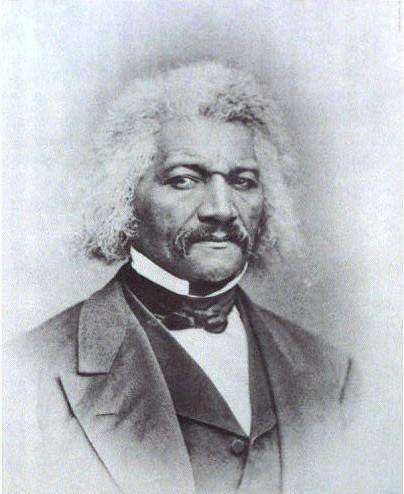
In this condition, Frederick Douglass no doubt played as the pioneer to lead African Americans to jump out of the oppressive situation. As one of the outstanding revolution leaders in American history, Frederick Douglass had always contributed himself to the equal citizenship for African American, especially for the slaves. As he perceived that the Constitution and the national system are not conceived with him in mind to begin with, he released the speech to call for change, which is effective and inspiring in my point of view. In the “What to the Slave Is the Fourth of July” speech, he had criticized the darkness side of the slavery policy in America, by first affirmed the humanity values embraced in the Declaration and the U.S. Constitution, and then query if the values have been correctly and fully pursued by the Americans.
Douglass has first strongly confirmed the important meaning of the American fathers who were brave to fight against the British colony, as at the start of the speech he mentioned that the fathers of America donated their whole lives into the freedom from the English colonies to look for wisdom and the justice for the country and their future (Douglass 1852: paragraph 6). Besides, the democratic leader has embraced the supremacy of Constitution and “Declaration of Independence”. He had affirmed the values of the Declaration such as “… the Declaration of Independence is the ring-bolt to the chain of your nation’s destiny” and he would regard the principles and obey them at any cost and efforts in any situation (Frederick 1852: paragraph 16). While presenting such acknowledgement, he seemed to keep him at a distance by using “your fathers”, and such distance in fact is prepared for the further strong argument he proposed about the human rights distance between black African Americans and white Americans, as he argued that the inheritance of liberty, justice, independence and prosperity earned by the American fathers were shared by the white people instead of black people (Gouglass 1852: paragraph36).
This transition expressed clearly his argument on whether the American citizenship has been correctly pursued and protected by the nation and its people. And Douglass’s behaviors and arguments can be well explained by what Du Bois (2015: 43) mentions that people view the black people problem in fact as an issue of national morality and human rights. The America nation shall be willing to judge its people depending on their characters and abilities, with no reference to their ethnicity or skin colors. If the society does not affirm a human being’s right of ‘life, liberty, and the pursuit of happiness,’ simply because he is African American, then the society had been back to the 19th century. What Douglass called for black people is exactly the “life, liberty and the pursuit of happiness”. This is so understandably under the historical context when the Enlightenment ideals at that time were raised up and scholars like Rousseau proposed the concept of “The Development of a People”. The French and American revolutions as well as the voice of Douglass were taking power from the ideals to break out the chains on black people and slaves.
Another loud argument Douglass made to oppose slavery system is related to the church and Christian religion. Phillis Wheatley, the first black female poet in the U.S., who was kidnapped and sold as a slave when she was seven or eight years old to North America by the New England colonies, praised the slavery led her to the Christianity. While in her another poem, she also mentioned that to be slavery was a “cruel fate” (Wheatley, 1773). As Douglass mentioned, there is no law, justice, humanity or religion for the black people in the United States at that moment. Church stood with the oppressors that taught slaves how to be a slave appropriately instead of showing true mercy on releasing the pain. Religion and God had become the tool for oppressors to brainwash the whole nation. On the other hand, the justice for slaves was absent - as the Fugitive Slaves Law stimulated the corruption of judge as an American judge could obtain 10 dollars to consign each criminal suspect as slave (Douglass 1852, paragraph 57). The corruption at that moment put the American citizens especially black people into a fearful situation that human rights are no longer guaranteed as one can easily be charged for guilty. Douglass pointed out that it was not simply the church and religion that threatened the safety of American citizens, while the backstage manipulator for them was the person in power, or to say, the national system. Hence Douglass sharply unveiled the cover over the morbid slavery policy and stabbed his sword of words directly into the heart of the people behind. Yet he still believed that the nation was not incurable, as the values of freedom, quality and happiness that he pursued for had always been written in the Constitution and “Declaration of Dependence”, which were also the origins of the United States.
In conclusion, Douglass who has been deeply motivated by the Enlightenment ideals had discovered the illness of slavery policy and awakened his people through the profound speech, by which he reminded the people that the nation was still young and the damage of the unreasonable slavery system shall impose great concerns about the Americans’ citizenship. He first affirmed the values of Constitution and “Declaration of Independence”, and then proposed the argument that slavery policy went against the national values, due to the unfair events happened to slaves and the rotten system of church and justice. What he proposed was considerably effective under the historical context that time when revolutions against slavery policy were everywhere. Even though he did not lead a physical rebel, what Douglass proposed has pointed out a light for the perplexed citizens to fight for their rights and happiness.
Reference
Du Bois, W. E. B. The Problem of the Color Line at the Turn of the Twentieth Century: The Essential Early Essays. Ed. Nahum Dimitri Chandler. New York: Fordham University Press, 2015.
Haitian Constitution of 1801.
W.E.B. Du Bois. The Souls of Black Folk: Essays and Sketches. A.C. McClurg & co, 1903.
Wheatley, P. On Being Brought from Africa to America. Poems on Various Subjects Religious and Moral. London.1773.
51due留学教育原创版权郑重声明:原创assignment代写范文源自编辑创作,未经官方许可,网站谢绝转载。对于侵权行为,未经同意的情况下,51Due有权追究法律责任。主要业务有assignment代写、essay代写、paper代写服务。
51due为留学生提供最好的assignment代写服务,亲们可以进入主页了解和获取更多assignment代写范文 提供北美作业代写服务,详情可以咨询我们的客服QQ:800020041。